A consumer picks up a personal care product, looks at the container and decides to try it. They press the dispenser. If the product does not come out as expected, takes too much effort or the dosing is awkward, their perception of the product can change in a matter of seconds.
To the consumer it may seem like a detail; to the company it means a user experience that does not live up to the product it developed. That is why, when a company selects a dispenser, the decision should not depend solely on price or on whether it visually matches the container.
The dispenser is also part of the product
In cosmetics and personal care, the container does not end at the bottle. The consumer interacts directly with the closure and dosing system every time they use the product.
This means that the dispenser can influence aspects such as:
- Ease of use.
- Dosing.
- Comfort.
- Perceived quality.
- Cleanliness during application.
- Overall experience with the product.
A formula may be perfectly developed and a container may have an excellent presentation, but if the dosing system creates a poor experience, there is a disconnect between the product the company wants to offer and what the consumer actually experiences.

The mistake of choosing on price
From Purchasing's standpoint, it is logical to seek cost efficiency. The problem appears when the cost per piece becomes the main selection criterion.
Two dispensers may have different prices and look similar in a quote, but they do not necessarily offer the same performance for a given application. Before making a decision, it is worth analyzing:
- How will the product be used?
- How much needs to be dispensed?
- How often will it be used?
- How does the dispenser interact with the product and the container?
- Does the application experience match the brand's positioning?
These questions help prevent a purchasing decision from causing problems after launch.
Compatibility goes beyond whether the cap closes
A dispenser should not be evaluated as an independent part. It must work properly together with the container and the closure system.
The thread, the container neck, the dosing mechanism and the characteristics of the product must be considered as part of the same solution. This is especially relevant in the cosmetics industry, where there are products with different viscosities, application formats and dosing needs.
The fact that a cap can physically be placed on a container does not necessarily mean it is the best solution for the product.
The problem can appear after the purchase
One of the most costly mistakes is detecting problems when the product is already in production. If a dispenser does not work as expected, changing it later can involve:
- Process adjustments.
- Changes to components.
- Inventory of parts that will no longer be used.
- Rescheduling production.
- Launch delays.
- Additional logistics costs.
- Inspection of finished product.
That is why the evaluation should be carried out before scaling up the purchase. Proper testing can help detect performance and compatibility problems while they can still be corrected with less impact.
What should be evaluated before choosing a dispenser?
A more complete decision can consider five aspects:
This last point is particularly important when a product begins to grow in sales. The component that works for small-scale production must also be able to support the growth of the operation.
Plastimex in the cosmetics industry: dispenser + container in a single solution
For a cosmetics company, sourcing the container and the dispenser separately can complicate the development and sourcing process. Both components must be validated as compatible, different suppliers must be coordinated and any fit problem between the container and the dosing system must be resolved.
This is where working directly with a container manufacturer can be an advantage.
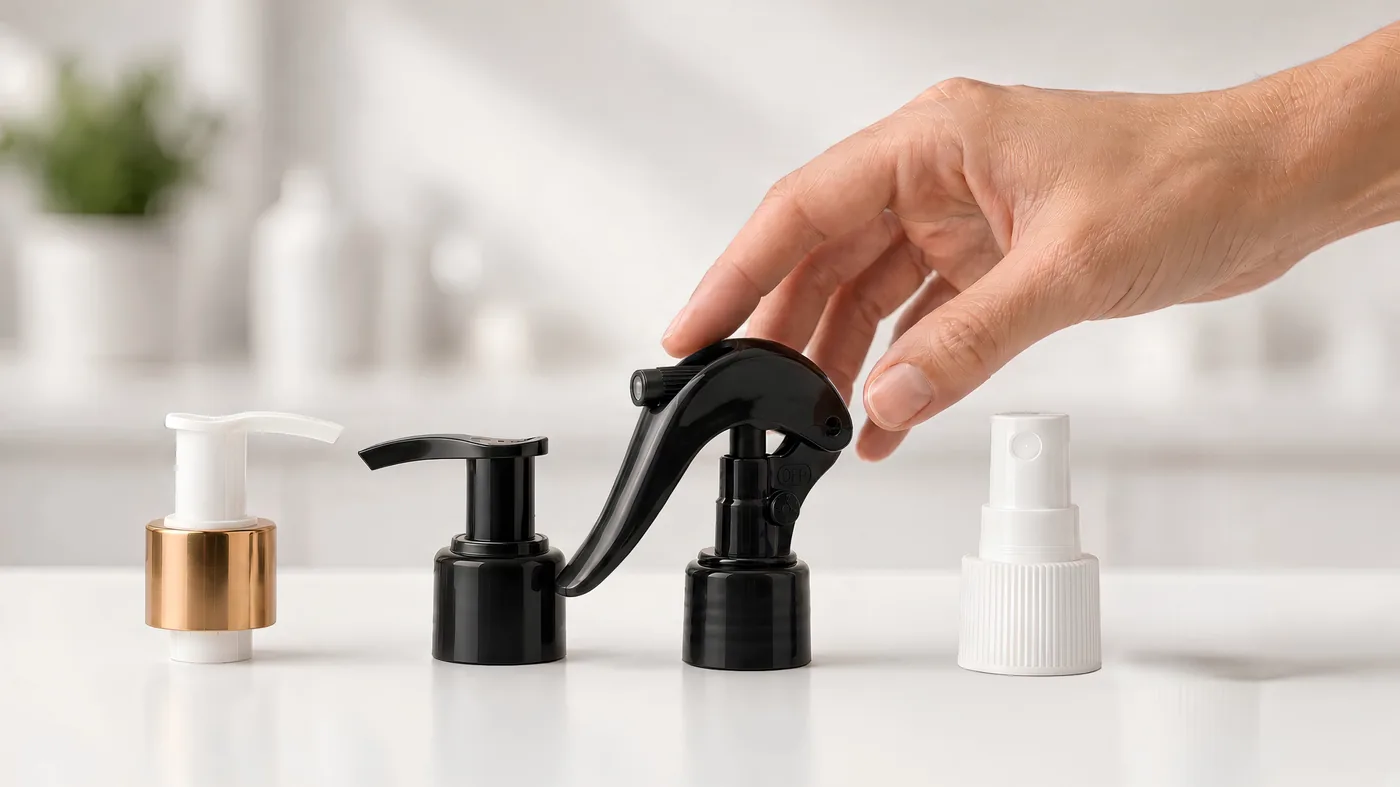
At Plastimex we have different dispenser and closure system options for cosmetic and personal care applications. Our catalog includes various models of sprayers and pumps that will help improve the use of your product.
As manufacturers, we can help you design the complete solution:
dispenser + container.
This makes it possible to approach the project from a comprehensive perspective and consider from the outset the relationship between the container, the neck, the closure and the dosing system.
For Purchasing, this means simplifying the evaluation of components. For Product Development, being able to work on the solution jointly. And for the company, it means reducing the chance of discovering compatibility problems when the product is already in production.
A complete solution starts before the purchase
When a company develops a cosmetic product, choosing the dispenser and the container separately can create more variables to resolve later. Working with a manufacturer that can handle both components makes it possible to evaluate the solution from a more complete perspective.
The conversation stops being: How much does this dispenser cost? and becomes: Which combination of container and dispenser works best for my product and my operation?
At Plastimex we manufacture solutions and components for different applications, including PET and HDPE containers, caps and accessories. As a Mexican manufacturer, we can offer a comprehensive solution for companies looking to develop or renew cosmetic and personal care products.
A dispenser may seem like a small component of the product, but it is one of the parts the consumer uses directly. And when that experience does not work, the problem ends up directly affecting how the customer perceives the product.
Don't choose the dispenser on price or appearance alone. Evaluate container + dispenser + application as a single solution. Talk to us and learn about the options we can integrate for your project.

This site needs JavaScript for the full experience (quote builder, filters,
gallery). Email us at
atencion.clientes@plastimex.mx
or call +52 55 5276 2977.